

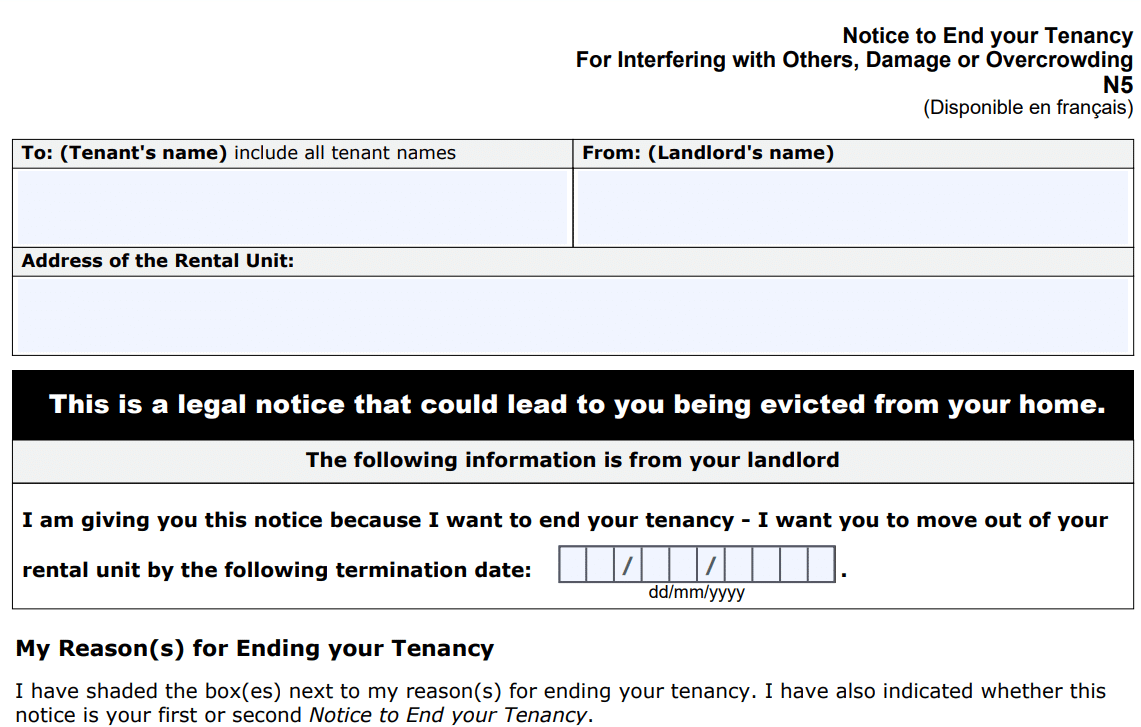
The N5 is the Landlord and Tenant Board notice an Ontario landlord uses to end a tenancy when a tenant interferes with other people, damages the rental unit, or allows too many people to live in it. It names the problem, gives the tenant 7 days to correct it, and sets a date the tenancy would end if the tenant does nothing.
Here is the part that catches landlords out. An N5 is not an eviction. It is the first step in a longer process, and a single error on the form or in how you serve it can send you back to the start after months of waiting at the Board. This guide explains when the N5 applies, how to complete and serve it, what the 7 day window actually means, and how a matter moves to a hearing when a tenant does not fix the problem. It reflects how we handle these files for landlords in Toronto and Ottawa.
What is the N5 notice and what does it do?
The N5 is one of several notices created under the Residential Tenancies Act, 2006, the provincial law that governs most residential rentals in Ontario. Its full name is the Notice to End your Tenancy For Interfering with Others, Damage or Overcrowding. You can download the current version free from the Landlord and Tenant Board, and you should always use the Board’s current form rather than an older copy.
The notice does two things at the same time. It puts the tenant on formal notice that their conduct is a problem the law treats seriously, and it starts the clock on a possible eviction. For a first N5, it also gives the tenant a way to keep the tenancy. Correct the problem inside the 7 day window and the notice is cancelled, which the Act calls being voided, and the tenancy continues as though the notice was never given.
In our practice, the landlords who do well at the Board are the ones who treat the N5 as a legal document rather than a strongly worded letter to a difficult tenant. The Board cannot rewrite a vague or incorrect notice for you. A notice cannot be amended once served. Only an application can. Get the notice right and everything after it runs more smoothly.
When can you use an N5, and when can you not?
The N5 covers three grounds. Each one ties to a specific section of the Residential Tenancies Act, and each has its own way of being corrected.
Reason 1 is substantial interference under section 64. This covers conduct by the tenant, a guest, or another occupant that substantially interferes with another tenant’s or the landlord’s reasonable enjoyment of the property, or with another lawful right of the landlord or other tenants. Ongoing late night noise, smoking that drifts into other units, blocking shared access, and unpaid utility charges the tenant agreed to cover are common examples.
Reason 2 is damage under section 62. This applies when the tenant, a guest, or another occupant wilfully or negligently damages the unit or the building.
Reason 3 is overcrowding under section 67. This applies when more people live in the unit than health, safety, or property standards permit.
The word that carries the most weight in Reason 1 is substantial. Ordinary living sounds, footsteps above you, children playing, a normal conversation through a wall, do not meet the standard even when a neighbour finds them irritating. The Board looks for conduct that is unreasonable and that genuinely disrupts other people. We raise this with landlords early, because an interference case built on minor annoyances rarely survives a hearing.
The three N5 grounds and how a first notice is voided.
| Ground | RTA section | What it covers | How the tenant voids a first N5 |
|---|---|---|---|
| Interference | s. 64 | Substantial interference with reasonable enjoyment or a lawful right | Stop the conduct within 7 days |
| Damage | s. 62 | Wilful or negligent damage to the unit or complex | Repair the damage, or pay the reasonable cost to repair or replace, within 7 days |
| Overcrowding | s. 67 | More occupants than health, safety or property standards allow | Reduce the occupants to the number stated in the notice within 7 days |
If your complaint does not clearly fit one of these three grounds, the N5 is probably the wrong form, and a different notice or approach may apply.
Should you use an N5 or an N7?
The N5 is not always the correct form. Two situations point to the N7, the Notice to End your Tenancy For Causing Serious Problems, instead.
The first is interference where you live in the same building as the tenant and that building has three or fewer units. Section 65 lets a resident landlord in a small building use the N7 in that situation.
The second is damage you can prove was deliberate. If you are confident you can show the tenant caused the damage on purpose, the N7 is available under section 63 and carries a shorter 10 day notice period. If you are not sure you can prove intent, stay with the N5. We see landlords reach for the faster N7 and then struggle to prove deliberate conduct at the hearing, which can sink the whole application.
N5 and N7 at a glance.
| Question | N5 | N7 |
|---|---|---|
| Main use | Interference, damage, or overcrowding | Serious problems, including an act that seriously impairs safety, deliberate damage, or a resident landlord’s enjoyment in a small building |
| Can the tenant void it? | Yes for a first N5, within 7 days | No |
| Notice period | 20 days for a first notice, or 14 days for a second within 6 months | 10 days |
| When it fits | Most interference and damage cases | Deliberate damage you can prove, safety risks, or interference affecting a resident landlord in a building of three or fewer units |
When you are unsure which notice fits, that is the right moment to get advice, because the choice drives the notice period and what you must prove.
How do you complete the N5 correctly?
Start with the basics. Name every tenant on the lease. If there is a subtenant or an assignee, name them too. You do not need to name other occupants such as children. Fill in your name as landlord, the full address of the rental unit, and the reason boxes that apply.
The section that decides most cases is the part where you describe what happened. A line like the tenant is too loud will not survive a hearing. Compare that to a dated account. On June 3, June 9, and June 14, 2026, between 1 a.m. and 3 a.m., the tenant played amplified music loud enough to be heard in units 4 and 6, and both neighbours sent written complaints. Write each incident with the date, the time, what happened, and who it affected. Attach extra pages if you run out of room. Specifics win at the Board, and vague summaries lose.
Then set the termination date. The earliest date you can use depends on whether this is the tenant’s first or second N5 in the past 6 months.
- For a first N5 in the past 6 months, the termination date must be at least 20 days after you give the notice.
- For a second N5 in the past 6 months, the termination date must be at least 14 days after you give the notice.
One timing trap deserves its own line. If you serve the notice by mail, the Act treats it as given on the fifth day after you mail it, under section 191(3). That means you add 5 days before you start counting to the termination date. Serve a first N5 by mail and you are really giving 25 days, not 20. Miss this and the notice can be found invalid.

How does the 7 day void period work?
For a first N5, the tenant has 7 days from the day they receive the notice to put things right. What counts as putting things right depends on the ground, as set out in the table above. Stop the conduct for interference, repair or pay for damage, or reduce the number of occupants for overcrowding.
If the tenant does this within 7 days, the notice is voided and you cannot apply to evict based on it. Just as important, you cannot apply during those 7 days either. The Act bars a landlord from applying to the Board on an N5 until the remedy period has passed without the tenant fixing the problem, under section 70. Filing on day 3 is one of the fastest ways to have an application thrown out.
How do you serve the N5 on the tenant?
You can give the notice to the tenant in several ways. You can hand it to the tenant or to an adult in the unit, leave it in the mailbox or where mail is ordinarily delivered, slide it under the door or through a mail slot, send it by fax to a fax machine at the tenant’s home or business, send it by courier, or send it by regular mail. Email is allowed only when the tenant has agreed to be served by email.
You cannot tape the notice to the outside of the tenant’s door. The Board does not treat posting on the door as valid service for a termination notice, and we have seen landlords lose months because of that one shortcut. Whatever method you choose, write down the date, the time, and the method, and keep a Certificate of Service. If you serve by mail, remember the deemed service date is the fifth day after mailing, and reflect that on your Certificate of Service.
What happens after the 7 days, and how do you file an L2?
If the 7 days pass and the tenant has not corrected the problem and has not moved out by the termination date, your next step is an application to the Board, not a second notice. The form is the L2, the Application to End a Tenancy and Evict a Tenant. You do not serve a fresh N5 first. The second N5 is a separate tool for a different situation, covered in the next section.
You must file the L2 within 30 days of the termination date set out in your notice, under section 69(1). File a copy of the N5 and the Certificate of Service together with the application, or the Board can refuse or dismiss it. As of June 2026, the L2 filing fee is $186 through the Tribunals Ontario Portal or $201 by mail or in person. Fees change, so confirm the current amount on the Board’s website before you file.
After you file, the Board schedules a hearing where you present your evidence and prove the conduct you described in the notice actually happened. Only the Board can order an eviction, and only the Sheriff can enforce one. A landlord cannot change the locks, shut off utilities, or remove a tenant’s belongings. Doing so is itself unlawful and can expose you to a tenant claim.
Be realistic about time. The Board has worked through significant hearing backlogs in recent years, and the gap between filing and a hearing can run several months or longer. Confirm current timelines with the Board when you plan.
When can you skip the void period with a second N5?
Section 68 of the Act creates the second N5. If a further problem arises within 6 months of a first N5, and that problem would itself justify a notice for interference, damage, or overcrowding, or certain other grounds, you can give a second N5. The second notice does not give the tenant a chance to void it, carries a 14 day termination date, and lets you apply to the Board right away.
Two points here trip up landlords and many online guides. First, the second contravention does not have to be the same conduct as the first. A first N5 for noise followed within 6 months by damage can support a second N5. Second, a second N5 only stands if a valid first N5 was given. If the first notice was defective, or there was no first notice at all, the Board can find the second N5 void, because the tenant was never properly given the chance to correct the problem that the law requires. When you apply on a second N5, you file both notices and both Certificates of Service.
The mistakes we see landlords make
A handful of errors account for most of the N5 files that fall apart. Each one is avoidable.
- Vague details. Noisy or messy gives the Board nothing to rule on. Dates, times, and specifics are what prove a case.
- The wrong notice period, or forgetting the 5 mailing days. A first N5 needs 20 days, and mail adds 5 more. An off date can void the notice.
- Posting the notice on the door. It feels efficient and it is not valid service. The cost is a dismissed application and a fresh start.
- Applying during the 7 day window. Section 70 forbids it. File too early and the application is dismissed.
- Waiting too long on damage. Get at least two written repair estimates and act while the tenant is still in the unit. If you sit on known damage until the tenant moves out, you can lose the right to apply.
- Treating ordinary living as interference. Normal household sound is not substantial interference. Building a case on it wastes the filing fee and months of time.
- Missing the 30 day filing deadline. Once the termination date passes, you have 30 days to file the L2. Miss it and you start over with a new notice.
Frequently asked questions
Can I evict a tenant right away with an N5?
No. An N5 is a notice, not an eviction. For a first N5 the tenant has 7 days to fix the problem, and even after that only the Board can end the tenancy, through an L2 application and a hearing. Only the Sheriff can enforce an eviction order. The fastest lawful route still runs through the Board.
What happens if the tenant fixes the problem within 7 days?
For a first N5, correcting the problem inside 7 days voids the notice, and the tenancy continues as if it was never given. You cannot then apply to evict on that notice. If the same kind of problem comes back within 6 months, you can serve a second N5, which the tenant cannot void.
Can I post the N5 on the tenant’s door?
No. Posting a termination notice on the door is not a valid method of service, and using it can get your later application dismissed. You can hand the notice over, put it in the mailbox or mail slot, slide it under the door, courier it, fax it, or mail it. If you mail it, count service as the fifth day after mailing.
How long does the whole process take?
The notice and void period take a few weeks. The unpredictable part is the wait for a hearing after you file the L2, which has run several months or longer given the Board’s caseload. If you are counting on a quick turnaround, plan for a longer one instead and confirm current timelines with the Board.
Do I need a lawyer or a paralegal to use an N5?
You can serve an N5 and file an L2 yourself, and many landlords do. The reason people bring these files to us is that the notice is technical and a single error can cost months. We can review the notice before you serve it, prepare the L2, and represent you at the hearing. A free 15 minute consultation is a low cost way to find out whether your situation needs that help.
What is the difference between an N5 and an N7?
The N5 covers interference, damage, and overcrowding, and a first one gives the tenant a 7 day chance to fix the problem. The N7 is for more serious situations, such as an act that seriously impairs safety, damage you can prove was deliberate, or interference affecting a resident landlord in a building of three or fewer units. The N7 cannot be voided and uses a shorter notice period. Choosing the wrong one is a common and costly mistake.
The information provided above is of a general nature and should not be considered legal advice. Every transaction or circumstance is unique, and obtaining specific legal advice is necessary to address your particular requirements. Therefore, if you have any legal questions, it is recommended that you consult with a lawyer.
