

An executor of an estate is the person who carries out the wishes in a will and settles the affairs of someone who has died. In Ontario, the law calls this person the estate trustee. You collect the assets, pay the debts and taxes, and give what is left to the people named in the will. The role carries real legal duties, firm deadlines, and personal liability if you handle it badly.
This guide explains what the role means, how you get the legal authority to act, what you must do, what you can be paid, and what happens when there is no will. It reflects current Ontario law, including the Estates Act, R.S.O. 1990, c. E.21, the Trustee Act, R.S.O. 1990, c. T.23, the Succession Law Reform Act, R.S.O. 1990, c. S.26, and the Estate Administration Tax Act, 1998, S.O. 1998, c. 34, Sched.

Need Help with Your Estate Planning?
Speak with an experienced estate planning lawyer in Ontario to get assistance with your matter.
Serving Clients Across Ontario
Remote Services Available
Client Focused & Flexible
What Is an Executor of an Estate?
An executor of an estate is the person a will names to manage and wind up a deceased person’s estate. Once a court confirms that authority, Ontario law refers to the same person as the estate trustee. You step into the shoes of the person who died, take control of the property, settle what is owed, and distribute the rest under the will.
The will gives an executor their authority, and that authority begins at the moment of death. Even so, banks, land registry offices, and other institutions usually want a court certificate before they release assets or accept your signature. That certificate is the proof that lets third parties rely on you.
Executor, Estate Trustee, or Administrator?
These words describe the same basic role in different situations. Ontario removed the old terms from its court forms years ago and now uses estate trustee for everyone, though people still use the older words in everyday speech. The table below shows how they line up.
| Term | When it applies | Where the authority comes from |
| Executor | Named in a valid will | The will itself |
| Estate trustee with a will | Court confirms a person named in the will | The will plus a court certificate |
| Estate trustee without a will | No will, or the will names no living trustee | A court appointment |
| Administrator | Older word for an estate trustee without a will | A court appointment |
What Does an Executor of an Estate Do?
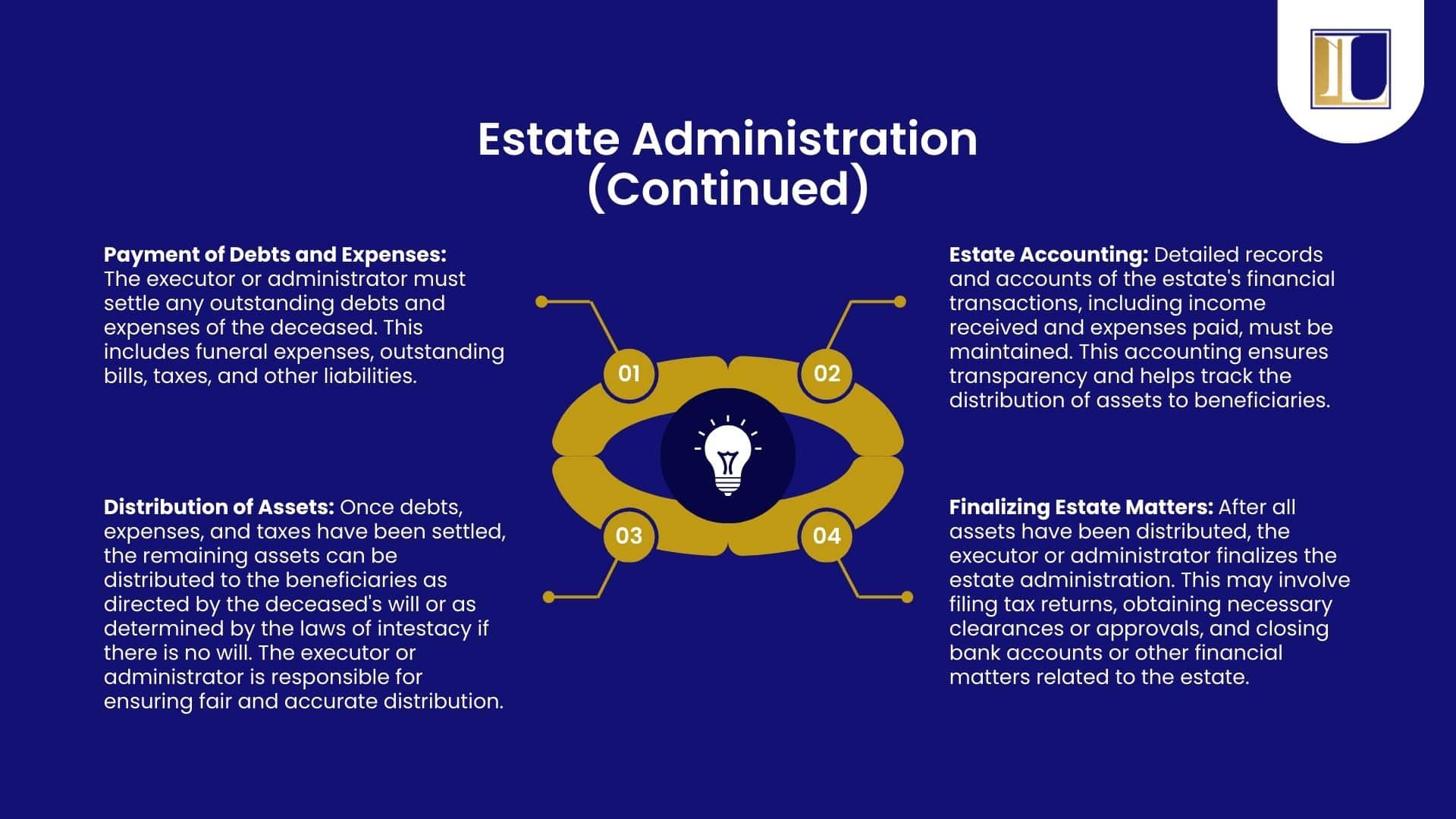
An executor of an estate secures the property, pays the debts and taxes, and distributes the remaining assets to the beneficiaries. The Trustee Act sets the standard of care you owe, and you must act honestly, carefully, and in the best interests of the estate. Your core duties are listed below.
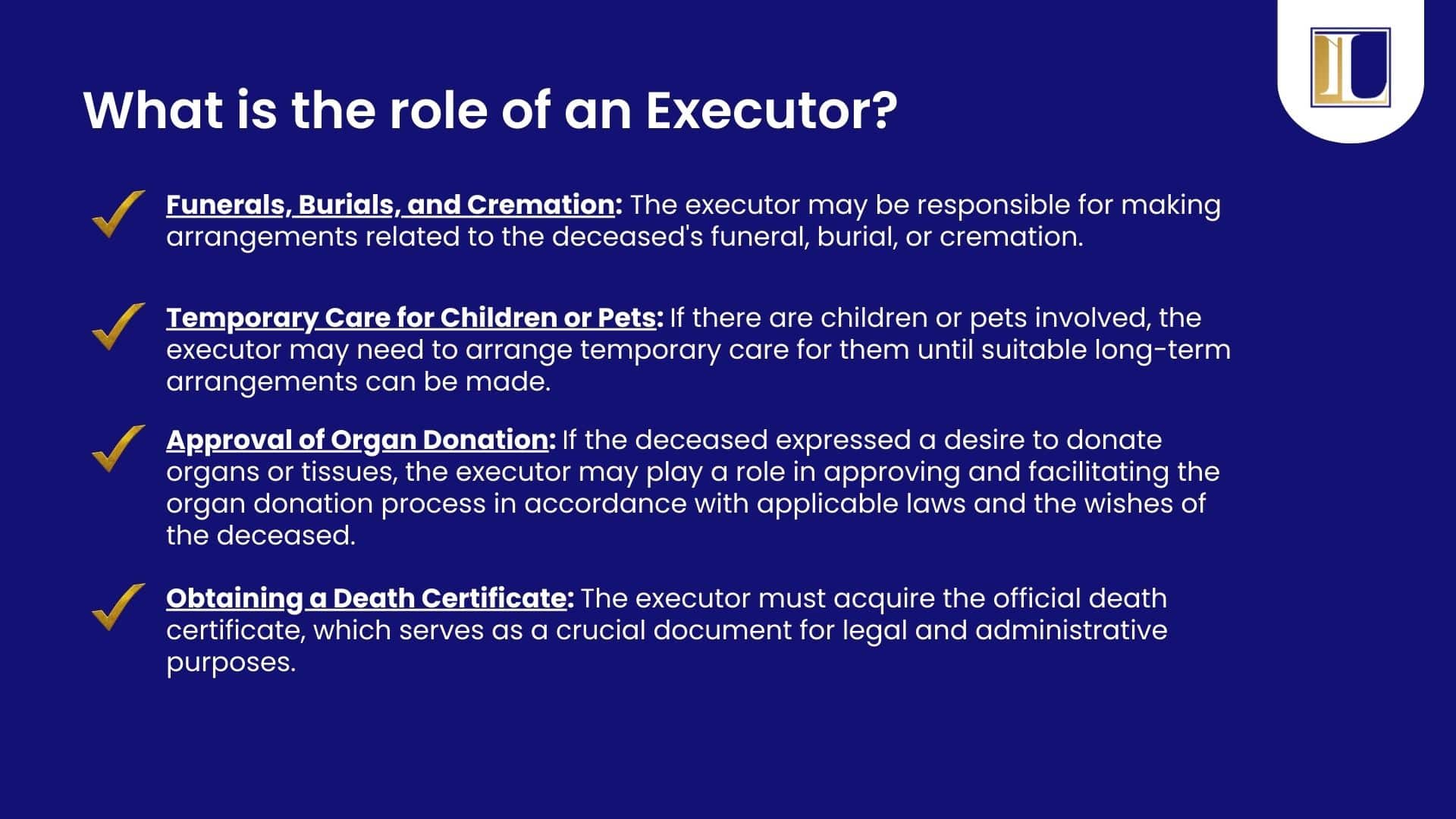
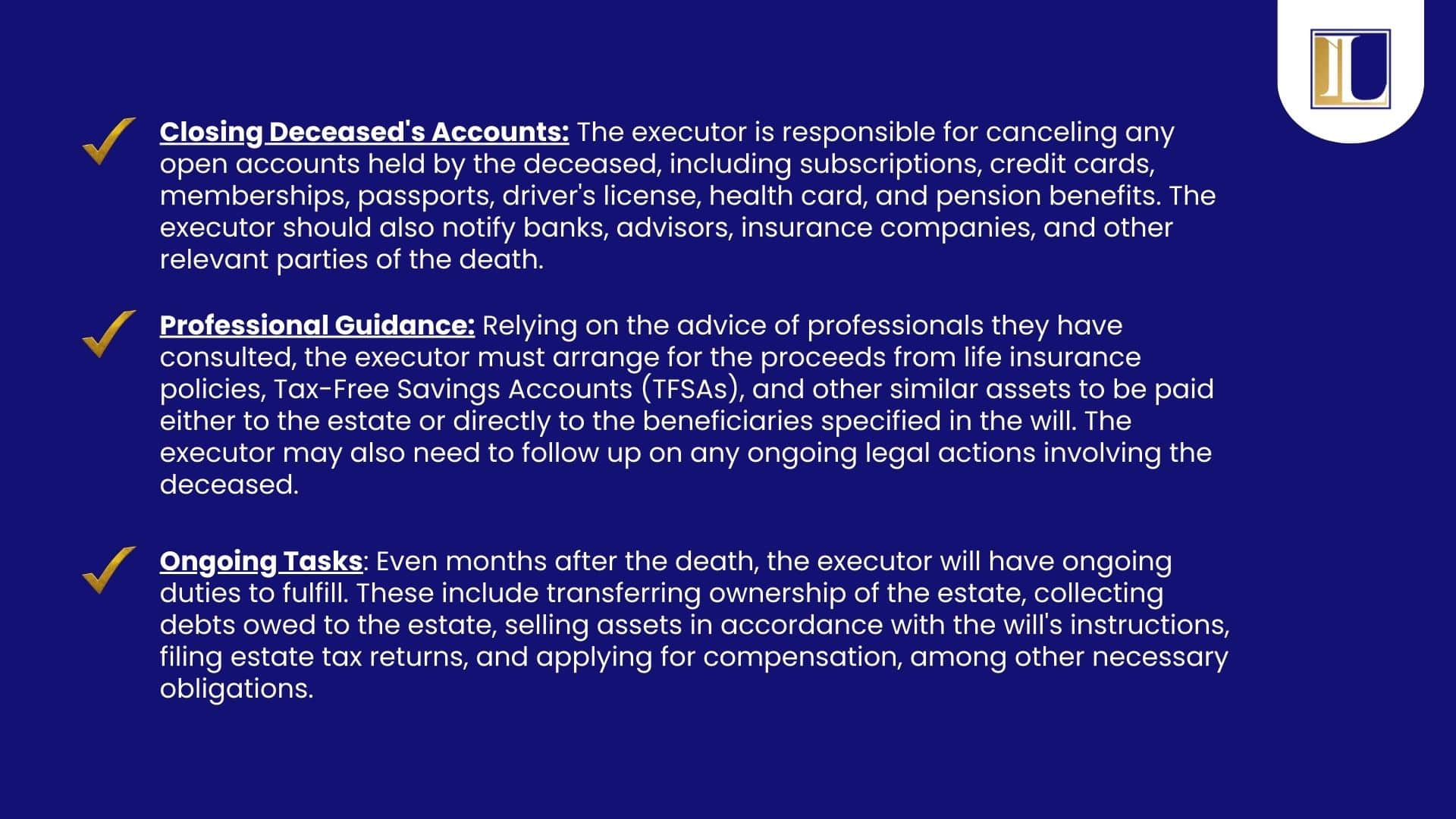
- Handle the urgent first steps. Arrange or confirm the funeral and check whether any dependent children or family members need immediate support.
- Find the will and proof of death. Locate the original will and any later changes to it, then get a death certificate or court order confirming the death.
- Secure and value the assets. Take control of bank accounts, investments, real estate, and personal property, and record their fair market value as at the date of death.
- Apply for probate when needed. Ask the court for a Certificate of Appointment of Estate Trustee if an institution or a real estate sale requires it.
- Notify the beneficiaries. Tell the people entitled to a share of the estate and serve them with the court application before you file it.
- Pay debts, expenses, and taxes. Settle funeral costs, valid debts, and the deceased’s final income tax. File the final return and ask the Canada Revenue Agency for a clearance certificate before you pay out the estate.
- Keep clear accounts. Track every dollar that comes in and goes out, because the beneficiaries and the court can ask you to account for it.
- Distribute the residue. Give the remaining property to the beneficiaries under the will, or under the intestacy rules if there is no will.
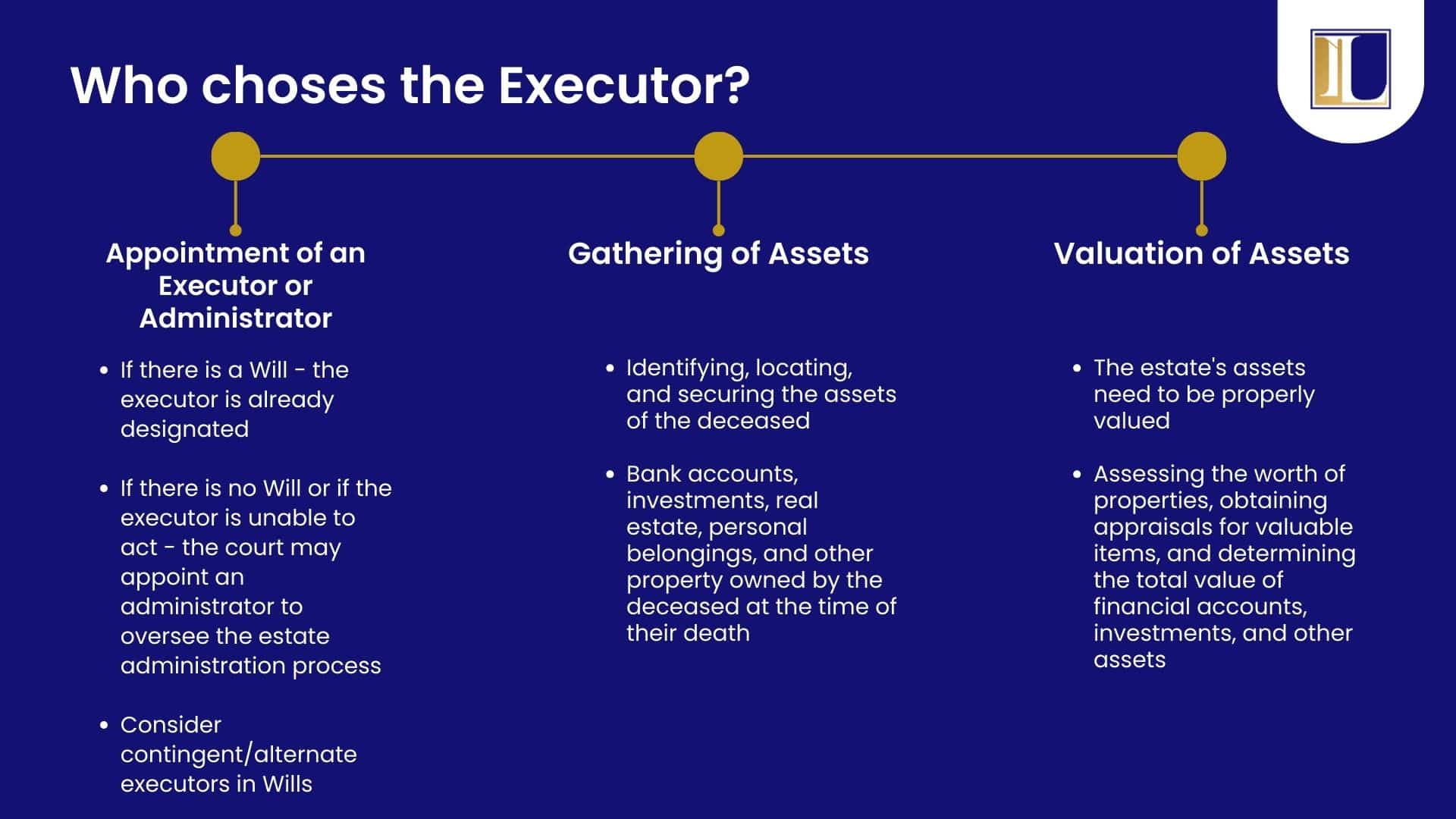
- File the Estate Information Return. Within 180 calendar days of receiving the certificate, file this return with the Ministry of Finance, listing the value of the estate at the date of death. See the Ontario estate administration tax page for the filing rules.
How Do You Become the Executor of an Estate in Ontario?
You become the recognized executor by applying to the Ontario Superior Court of Justice for a Certificate of Appointment of Estate Trustee, the document most people call probate. The Ontario government’s probate page sets out the full process. The main steps are below.
- Confirm you need probate. Probate is not always required. If the deceased owned real estate or assets held by a financial institution, the estate normally has to be probated.
- Value the estate. Add the total value of all real and personal property the deceased owned at the date of death. You report this figure on the court application.
- Complete the court forms. Fill out the Application for a Certificate of Appointment of Estate Trustee (Form 74A) and the supporting affidavits. You must swear these before a commissioner for taking affidavits, who also signs the document.
- Serve the beneficiaries. Send a signed copy of the application to everyone entitled to a share of the estate before you file it with the court.
- Pay the tax and file. Pay the Estate Administration Tax as a deposit and file the application at the court in the county or district where the deceased lived.
- Receive the certificate. The court typically processes a complete application within 15 business days, then issues your certificate. You then have 180 days to file the Estate Information Return.
If the estate is worth $150,000 or less, you can apply for a Small Estate Certificate instead, which uses a simpler set of forms. Estates above that figure use the standard certificate.
What Estate Administration Tax Must an Executor Pay?
The Estate Administration Tax is charged on the value of the estate when the court issues a certificate. The estate pays this tax, not you personally. Since January 1, 2020, the first $50,000 of the estate is exempt, and the rate above that is $15 for every $1,000 of value. The estate value is rounded up to the nearest thousand.
| Value of the estate | Rate that applies |
| First $50,000 | $0 (no tax) |
| Every $1,000 above $50,000 | $15 per $1,000 or part of $1,000 |
Here is how the math works for an estate worth $240,000.
| Step | Calculation | Amount |
| Exempt portion | First $50,000 | $0 |
| Taxable portion | $240,000 minus $50,000 | $190,000 |
| Tax on the balance | $190 thousands at $15 each | $2,850 |
| Total tax payable | Paid by the estate | $2,850 |
This exemption is a recent change. Before 2020, the estate paid $5 for every $1,000 on the first $50,000, so smaller estates now keep more. The full rules and an official calculator sit on the Ontario estate administration tax page.
When Does an Executor Need a Bond?
An estate administration bond is a guarantee that protects the beneficiaries if you mismanage the estate. Under section 35 of the Estates Act, the court requires a bond in three situations, listed below.
- The deceased died without a will.
- The deceased had a will, but it does not name the applicant as estate trustee.
- The applicant lives outside Canada and outside the Commonwealth.
The bond amount must be double the value of the estate unless a judge orders otherwise. A judge can also dispense with the bond, which often happens when the beneficiaries are adults who consent. Preparing that motion can be involved, so many applicants ask a lawyer to handle it.
How Much Does an Executor of an Estate Get Paid?
Section 61(1) of the Trustee Act entitles an executor to a fair and reasonable allowance for the care, pains, trouble, and time spent on the estate. The statute sets no fixed price, so Ontario courts apply a tariff that has grown out of decided cases. The common starting point works out to roughly five percent of the value of the estate, broken down below.
| Compensation component | Usual rate |
| Capital received into the estate | 2.5% |
| Capital paid out of the estate | 2.5% |
| Income received | 2.5% |
| Income paid out | 2.5% |
| Care and management of ongoing assets | 2/5 of 1% of the average yearly value |
This tariff is only a guide. A court can raise or lower the amount using five factors first set out in Toronto General Trusts Corp. v. Central Ontario Railway (1905), which look at the size of the estate, the care and responsibility involved, the time spent, the skill shown, and the success achieved. A will can also fix the compensation or leave nothing at all. Where there are several executors, they share the one allowance. Executor compensation counts as taxable income in your hands.
What Happens If There Is No Will?
When a person dies without a valid will, they die intestate, and Part II of the Succession Law Reform Act decides who inherits. The court appoints an estate trustee without a will, usually the spouse first, then a close adult relative. Planning ahead with a lawyer through a will and estate plan avoids this outcome.
A married spouse gets a preferential share off the top of the estate before anyone else. For deaths on or after March 1, 2021, that share is $350,000. The rest of the estate is then split as shown below.
| Family situation | How the estate is divided |
| Spouse, no children | The spouse inherits the entire estate. |
| Estate worth $350,000 or less, with a spouse | The spouse inherits everything. |
| Spouse and one child | Spouse takes the first $350,000, then the spouse and child split the rest equally. |
| Spouse and two or more children | Spouse takes the first $350,000, then one third of the rest goes to the spouse and two thirds is shared among the children. |
| No spouse, children only | The children share the estate equally. |
The $350,000 figure is a recent increase. It rose from $200,000 in 2021, the first change since 1995, when the share moved up from $75,000. A common law partner does not inherit automatically under these rules, no matter how long the relationship lasted, but may bring a claim for support as a dependant under Part V of the Act. A married spouse who was separated at death may be treated as having died first in some cases.
What Are the Legal Duties and Risks of an Executor?
An executor is a fiduciary, which means you must put the estate ahead of your own interests. That duty creates both responsibilities and personal risk. The main ones are listed below.
- Act in good faith. Manage the estate honestly and with the care a careful person would use for their own affairs.
- Stay even handed. Treat all beneficiaries fairly and do not favour one over another, including yourself.
- Avoid personal gain. Do not use estate property for your own benefit or place yourself in a conflict with the estate.
- Watch the tax trap. If you distribute the estate before getting a clearance certificate from the Canada Revenue Agency, you can be held personally liable for unpaid tax.
- Account when asked. A beneficiary can require you to pass your accounts before the court, which reviews how you managed the estate and your compensation.
If no suitable person will act, the Office of the Public Guardian and Trustee can step in as estate trustee of last resort in limited circumstances.
Who Can Be an Executor of an Estate?
Almost any adult of sound mind can serve as an executor. You do not need legal or financial training, though the job rewards organization and patience. A few practical points are listed below.
- Adults only. A minor cannot act as estate trustee, so a will should always name an adult.
- Beneficiaries can serve. A spouse, child, or other beneficiary can also be the executor, and this is very common.
- Professionals and trust companies qualify. You can name a lawyer, accountant, or trust company, often as a joint trustee with a family member.
- People outside Canada can serve. A person who lives abroad can act, but usually must post a bond.
- The court can refuse a poor choice. A judge can decline to appoint someone who is unfit, unwilling, or in a clear conflict with the estate.
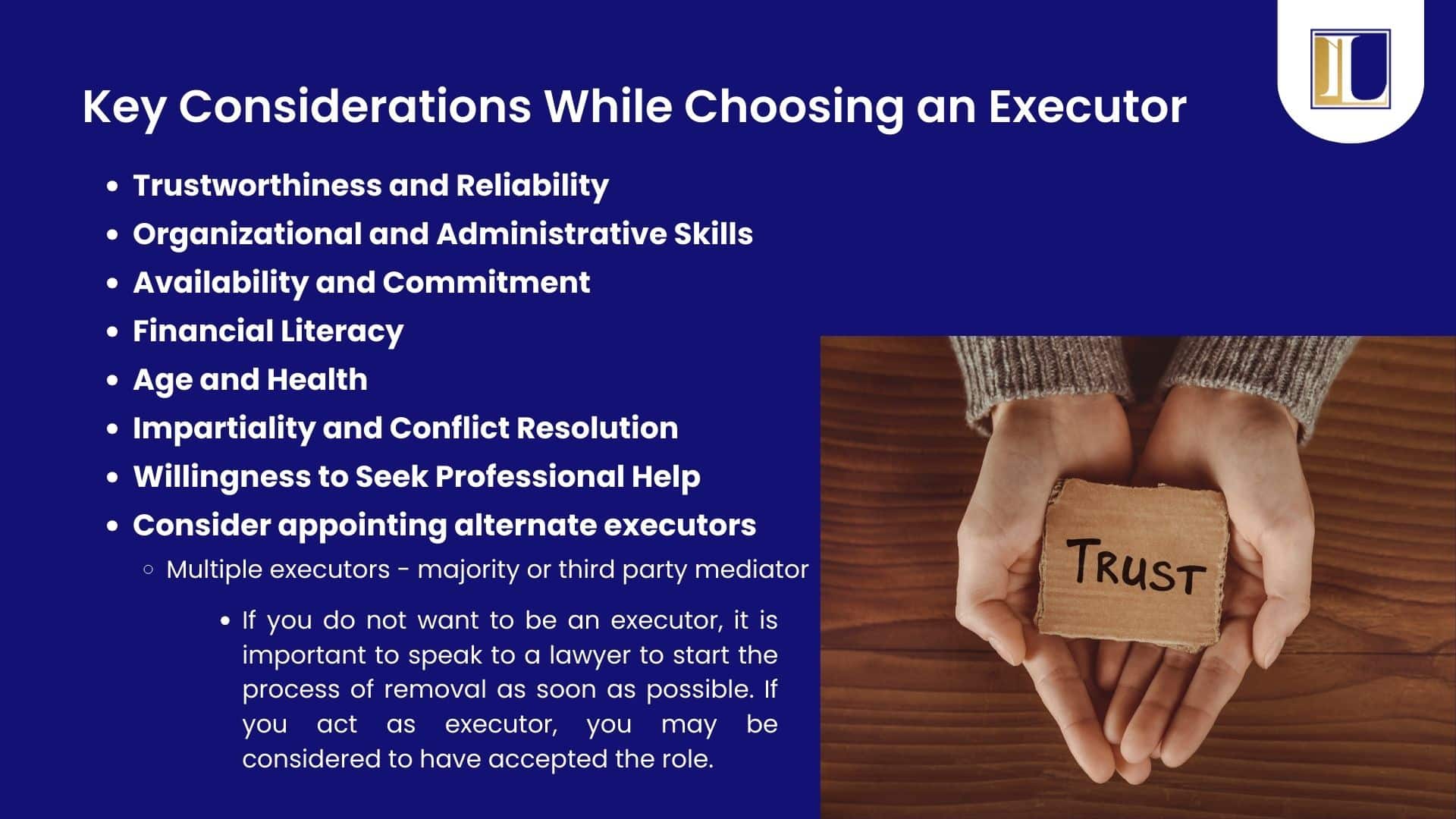
You can also name alternates in case your first choice cannot act, and a named executor who does not want the job can sign a renunciation to step aside. For business owners, lining up the right people is part of business succession planning as well.
How Do You Choose the Right Executor?
Choosing the right executor matters as much as the rest of your will. The job can run for months or years and touches money, family, and the law, so weigh the points below before you name anyone.
- Trust and integrity. Pick a person with a steady record of honesty, because this person will control the estate’s money and property.
- Organization. Estate work means deadlines, paperwork, and records, so choose someone who keeps things in order.
- Time and commitment. Settling an estate takes real effort over a long stretch. Name someone who can give it proper attention.
- Comfort with money. Your executor handles accounts, debts, and distributions, so basic financial sense helps a lot.
- Age and health. Choose someone likely to outlive you and well enough to carry a demanding role.
- Fairness under pressure. If the beneficiaries might clash, pick someone who stays neutral and can calm a dispute.
- Willingness to get advice. A strong executor knows when to bring in a lawyer or accountant instead of guessing.
- Backups. Name one or more alternates so the estate keeps moving if your first choice cannot serve.
The table below sums up what to look for and what to avoid.
| Signs of a strong executor | Warning signs to avoid |
| Keeps clear, written records | Loses track of paperwork |
| Communicates with beneficiaries | Goes quiet or dodges questions |
| Stays neutral in family conflict | Takes sides among relatives |
| Asks for help on legal and tax issues | Guesses and hopes for the best |
| Available for the long haul | Likely to move away or step back |
When Should You Get Professional Help?
You can administer many estates on your own, but some situations call for a lawyer or accountant. The probate process alone trips up many first time executors. Watch for the signs below.
- You are unsure of your legal duties or your personal risk.
- The estate must go through probate, or someone may challenge the will.
- The tax filings are complex, or you need a clearance certificate from the Canada Revenue Agency.
- Beneficiaries or creditors are in conflict.
- The estate holds a business, foreign property, or assets that are hard to value.
Getting advice early usually costs less than fixing a mistake later, and the estate normally pays the reasonable cost. A wills and estates lawyer can take on as much or as little of the work as you need.
Frequently Asked Questions
Can an executor also be a beneficiary?
Yes. An executor can be a beneficiary, and this happens often when a spouse or adult child takes on the role. You still owe the same fiduciary duties to every other beneficiary, so you cannot use the position to give yourself an advantage.
How long does an executor have to settle an estate in Ontario?
Ontario sets no fixed deadline to finish an estate. Courts expect you to wind up a straightforward estate within about a year, often called the executor’s year. Complex estates, disputes, or property sales can take longer. The hard deadline you must meet is the Estate Information Return, due within 180 days of the certificate being issued.
Can you refuse to act as an executor?
Yes, as long as you have not already started dealing with the estate. A person named in a will can sign a renunciation and step aside, and an alternate or a beneficiary can then apply. Once you begin acting, stepping down is harder and may require a court order.
Does an executor have to pay the deceased’s debts personally?
No. Valid debts are paid from the estate’s assets, not from your own pocket. The risk comes if you distribute the estate too early. If you pay the beneficiaries before settling debts and taxes, you can become personally responsible for what remains unpaid.
Can an executor be removed?
Yes. A beneficiary or co trustee can ask the Superior Court of Justice to remove an executor who is not doing the job, who has a serious conflict, or who is putting the estate at risk. The court focuses on the welfare of the beneficiaries when it decides.
Do you always need probate to act as executor?
No. Probate is needed only when an asset holder requires it, which is common with real estate and larger bank or investment accounts. Small estates and assets that pass by survivorship or by beneficiary designation may not need a certificate at all.
The information provided above is of a general nature and should not be considered legal advice. Every transaction or circumstance is unique, and obtaining specific legal advice is necessary to address your particular requirements. Therefore, if you have any legal questions, it is recommended that you consult with a lawyer.
