
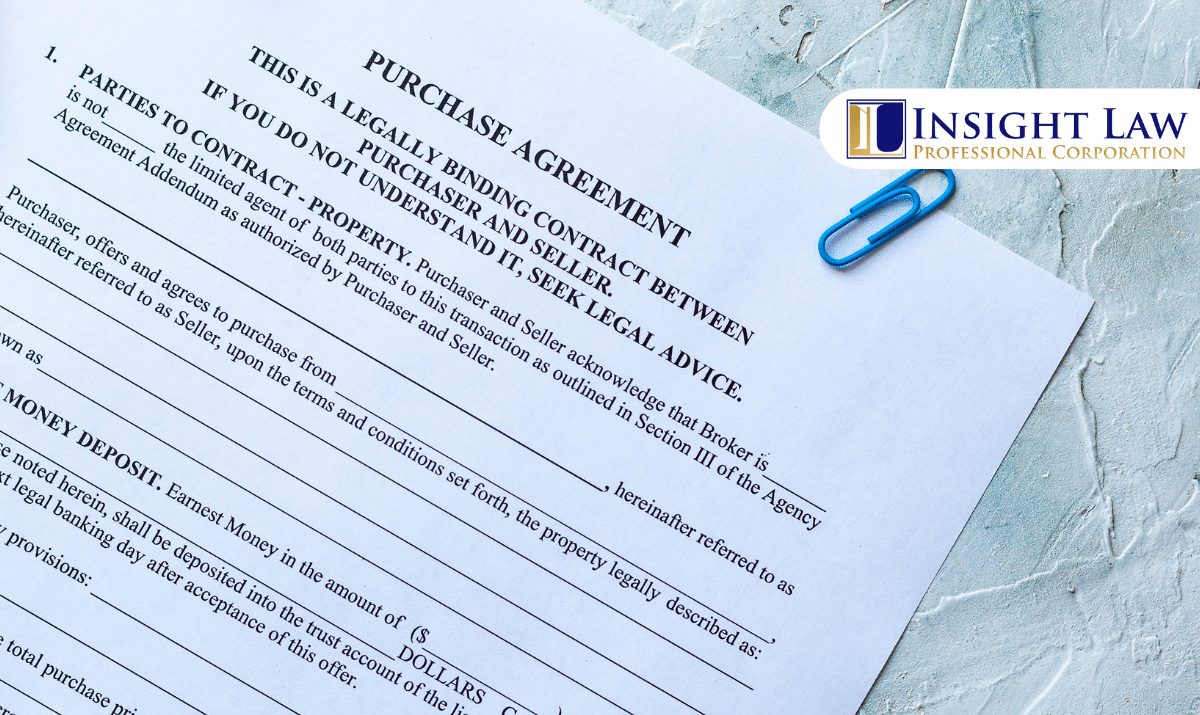
A sales and purchase agreement is the written contract that sets out the terms of a sale, who is buying, who is selling, what changes hands, the price, and the conditions each side must meet before the deal closes. In Ontario the phrase covers three very different documents, a real estate Agreement of Purchase and Sale, a business asset or share purchase agreement, and a contract for the sale of goods, and the law that governs each one is not the same.
Most online guides treat the agreement as one thing. In practice the document you sign, the law that controls it, and the tax you pay all depend on what you are buying. This guide from our Toronto business lawyers walks through the three kinds of agreement, what belongs in each, the Ontario rules that catch people out, and the mistakes that cost the most.
What is a sales and purchase agreement?
A sales and purchase agreement, sometimes shortened to SPA, is a binding contract that records the terms on which a seller transfers something to a buyer and the buyer pays for it. It names the parties, describes what is being sold, sets the price and how it is paid, lists the promises each side makes, and spells out the conditions that must be satisfied before the sale completes. Once both sides sign, it governs the deal until closing and often beyond.
The agreement does two jobs at once. It locks in the deal so neither side can walk away on a whim, and it allocates risk, who carries the cost if something goes wrong, who answers for a defect, and what happens if a condition is not met. A handshake leaves all of that unwritten. The agreement makes it enforceable.
The catch in Ontario is that there is no single sales and purchase agreement. What you sign depends on what you are buying.

The three agreements you might sign in Ontario
People use the term as a catch all, but in an Ontario deal it usually means one of three documents. Each is governed by different law and carries different tax.
Buying or selling real estate
For a house, condo, or commercial property, the contract is an Agreement of Purchase and Sale, usually the Ontario Real Estate Association standard form (OREA Form 100 for a residential resale, with separate forms for condominiums and commercial property). It must be in writing to be enforceable, the buyer pays land transfer tax on closing, and a Toronto property carries a second municipal land transfer tax on top. Our real estate lawyers in Toronto review this agreement before clients sign.
Buying or selling a business
When the deal is a business, the contract is either an Asset Purchase Agreement, where the buyer takes specific assets such as equipment, inventory, and goodwill, or a Share Purchase Agreement, where the buyer takes the shares of the company that owns those assets. The choice changes the tax both sides pay and the liabilities the buyer inherits. We cover this in detail in our guides to buying a business in Ontario and share versus asset sales.
Buying or selling goods
A sale of equipment, vehicles, stock, or other movable property is a sale of goods, governed by Ontario’s Sale of Goods Act. The Act fills in default terms when a contract is silent, including when ownership and risk pass from seller to buyer. In a business deal you can contract out of most of those defaults, which is exactly why a written agreement matters.
| What you are buying | The document | Governing framework | Main tax to plan for |
|---|---|---|---|
| Real estate (home or commercial) | Agreement of Purchase and Sale (OREA standard form) | Common law and Ontario real estate statutes, writing required under the Statute of Frauds | Land transfer tax paid by the buyer, plus Toronto municipal land transfer tax inside the city |
| A business, asset deal | Asset Purchase Agreement | Contract law and Ontario corporate statutes | HST on taxable assets unless the parties file the section 167 election |
| A business, share deal | Share Purchase Agreement | Contract law and the Business Corporations Act (Ontario) or its federal equivalent | Capital gains treatment for the seller, no HST on the shares |
| Goods (equipment, inventory, vehicles) | Sales agreement or bill of sale | Sale of Goods Act (Ontario) | HST where it applies |
When do you need a written agreement?
For some deals the law requires writing. For others it does not, but going without it is a risk you should not take.
Real estate, writing is the law
An agreement for the sale of land in Ontario must be in writing and signed to be enforceable. That rule comes from the Statute of Frauds, and it is why a verbal promise to sell a house, or a casual email exchange, generally will not hold up. Courts have enforced unwritten land deals in narrow cases where one side already carried out a large part of the bargain, but you never want to rely on that exception. Get it in writing.
Goods, the Act fills the gaps but rarely the way you want
A contract for the sale of goods can be verbal and still binding. The problem is what happens when something goes wrong. If your agreement is silent, the Sale of Goods Act decides questions like when ownership passes and who bears the loss if the goods are damaged before delivery. Those default rules may not match what you intended. A written agreement lets you set your own terms on price, delivery, payment, and what happens on a default.
A business, never on a handshake
No statute forces a business sale into writing, but no careful buyer or seller proceeds without one. A business sale involves employees, contracts, leases, tax, and often financing. The agreement is where you record the price, the adjustments, the representations about the business, the indemnities if those representations turn out to be wrong, and the conditions like landlord consent or lender approval. Leave any of that to memory and you are inviting a dispute.
So the rule of thumb is simple. If land is involved, you must have a signed written agreement. If goods or a business are involved, you are not legally required to, but the cost of skipping one almost always dwarfs the cost of drafting it.

What goes into a purchase agreement?
The details vary by deal, but most Ontario purchase agreements contain the same building blocks. Here is what to look for before you sign.
- The parties. Full legal names and addresses. For a corporation, the exact registered name, because a deal signed in the wrong name can be hard to enforce.
- What is being sold. A precise description. For real estate, the legal description and which fixtures and chattels are included. For a business, a schedule of exactly which assets or which shares. Vague descriptions cause fights.
- The purchase price and how it is paid. The total, the deposit, the balance due on closing, and how any price adjustment is calculated.
- Representations and warranties. Statements of fact each side promises are true, for example that the seller owns what they are selling and that no undisclosed claims sit against it. A false representation gives the other side a claim.
- Covenants. Promises about conduct before and after closing, for example that the seller will keep running the business normally until the deal closes.
- Conditions. Things that must happen before either side has to close, for example financing approval, a satisfactory inspection, or landlord consent on a lease.
- Indemnities. Who pays, and up to what limit, if a representation proves false or a liability surfaces after closing.
- Confidentiality. Protection for the sensitive information both sides exchange during the deal. Often this sits in a separate agreement signed earlier.
- Termination. The circumstances in which either side can walk away, and what happens to the deposit if they do.
- Dispute resolution and governing law. How a disagreement gets resolved and which law applies, almost always Ontario law for a deal here.

Purchase price, deposit, and conditions
The money section of a purchase agreement is rarely just a number. It sets out the deposit, the balance, how the price can move before closing, and the conditions that let a buyer walk away with the deposit intact.
The deposit
A deposit shows the buyer is serious and gives the seller something to hold if the buyer defaults. In a residential resale, the deposit is commonly a share of the price, paid within a short window after the offer is accepted and held in trust. The agreement should say who holds it, when it is due, and what happens to it if the deal falls through.
Conditions and the conditional period
Conditions are the buyer’s protection. A financing condition gives time to confirm a mortgage. An inspection condition gives time to check the property or the business. A status certificate condition applies to condos. During the conditional period the buyer can usually walk away and recover the deposit if a condition is not met. Once the conditions are waived, the deal is firm and the deposit is generally at risk if the buyer fails to close. Read the deadlines closely, because they are strict.
Price adjustments
On real estate, the lawyer prepares a statement of adjustments at closing that prorates property tax, utilities, and condo fees between buyer and seller. On a business, the price often adjusts for the value of inventory or working capital on the closing date. Know how your price can move before you sign.
Asset sale or share sale, which one fits?
If you are buying or selling a business, the single biggest decision in the agreement is whether to structure it as an asset sale or a share sale. The two are taxed differently and carry very different risk.
In an asset sale, the buyer picks up specific assets and usually leaves the seller’s liabilities behind. In a share sale, the buyer takes the whole company, the good and the bad, including liabilities that may not surface until later. Sellers often prefer a share sale for the capital gains treatment. Buyers often prefer an asset sale for the cleaner liability position. The right answer depends on the specific business, its tax position, and what each side will trade, which we work through with clients in our share versus asset sale guide.
| Asset sale | Share sale | |
|---|---|---|
| What the buyer gets | Selected assets, for example equipment, inventory, goodwill | All the shares, so the whole company |
| Liabilities | Generally stay with the seller unless the buyer agrees to take them on | Move to the buyer with the company |
| Seller tax | Gain can be taxed in the company and again on distribution | Often eligible for capital gains treatment, possibly the lifetime capital gains exemption |
| Buyer tax | Can often claim depreciation on the purchased assets | No fresh cost base on the underlying assets |
| HST | Applies to taxable assets unless the parties file the section 167 election | No HST on the shares |
| Often preferred by | The buyer | The seller |
This is a general comparison. The right structure turns on the facts of your business and your tax situation, so treat the table as a starting point for a conversation with your lawyer and accountant, not a final answer.
The Ontario details that catch people out
The Bulk Sales Act is gone, and old advice still mentions it
For a century, an asset buyer in Ontario had to comply with the Bulk Sales Act or risk having the sale set aside by an unpaid creditor of the seller. Ontario repealed that Act on March 22, 2017, the last province in Canada to do so. You will still find articles and templates telling buyers to complete bulk sales affidavits. They are out of date. What replaced that step is ordinary due diligence, including a search under the Personal Property Security Act to find registered claims against the seller’s assets before you close.
On real estate, the buyer pays land transfer tax, and Toronto charges it twice
Land transfer tax is a buyer cost, paid on closing and calculated on the purchase price. If the property sits inside the City of Toronto, the buyer pays a second municipal land transfer tax on top of the provincial one, which roughly doubles the bill. First time buyers can claim rebates that reduce or remove the provincial tax and part of the municipal tax. These figures change, so confirm the current rates and rebates with your lawyer before you budget.
HST can land on a business sale unless you plan for it
The sale of business assets can attract HST on the taxable items, which is a real cost if no one planned for it. Where the buyer is acquiring all or substantially all of the assets needed to run the business, the buyer and seller can jointly file an election under section 167 of the Excise Tax Act, on Form GST44, so that no GST or HST applies to the qualifying assets. The buyer files the form with the Canada Revenue Agency by the deadline for its GST/HST return covering the closing. Miss the filing and the relief can be lost, which is why the agreement should require the election and back it with an indemnity.
A signed agreement is binding, and that cuts both ways
Once you sign, you are committed to the terms, including deadlines you might not have read closely. Buyers sometimes treat the agreement as a formality and assume they can renegotiate later. They usually cannot. The time to get the terms right is before you sign, not after.
From signed agreement to closing
Signing the agreement is the start, not the finish. Between signing and closing, both sides work through the conditions and the searches that turn the agreement into a completed transfer.
The conditional period comes first, if there is one. The buyer confirms financing, completes inspections, and reviews whatever the deal requires, a status certificate on a condo, the leases and contracts on a business, the title on real estate. If the conditions are met, the buyer waives them and the deal becomes firm.
Then comes due diligence and document preparation. On real estate, the lawyer searches title, checks for liens and work orders, arranges title insurance, and prepares the transfer and the statement of adjustments. On a business, the lawyer runs corporate and Personal Property Security Act searches, finalizes the schedules, and prepares the closing documents and any tax elections.
On closing day, the balance of the price changes hands, ownership transfers, and any post closing obligations in the agreement, such as adjustments, indemnities, or a holdback, carry on from there. The practical step for you is to map every deadline in your agreement onto a calendar the day you sign, and make sure someone owns each one.
Frequently asked questions
Is a sales and purchase agreement legally binding?
Yes. Once both sides sign, it is a binding contract, and a court can enforce its terms if one side does not perform. That is exactly why the terms matter. The deposit clause, the conditions, and the deadlines all become enforceable obligations the moment you sign, so read them before you do.
Do I need a lawyer to review a purchase agreement?
You are not legally required to for most deals, though a real estate transfer in Ontario is registered by a lawyer. The practical answer is that a review before you sign is far cheaper than fixing a problem after. We read the agreement for the terms that carry risk, the description, the conditions, the indemnities, and the tax, and we flag anything that does not protect you.
What is the difference between a purchase agreement and a bill of sale?
A purchase agreement sets out the terms of the deal and the promises each side makes, before and after the transfer. A bill of sale is the shorter document that actually transfers ownership of goods at the moment of sale. In many goods deals you see both, the agreement that governs the deal and the bill of sale that records the transfer.
Can I get out of a purchase agreement after I sign it?
It depends on what the agreement says. If you are still in a conditional period and a condition is not met, you can usually walk away and recover your deposit. Once the conditions are waived, the deal is firm, and backing out can mean losing the deposit and facing a claim for the seller’s losses. There is no general right to change your mind.
Who pays HST on a business sale in Ontario?
It depends on how the deal is structured. A share sale does not attract HST on the shares. An asset sale can attract HST on the taxable assets, but where the buyer acquires all or substantially all of the business, the parties can jointly file the section 167 election on Form GST44 so that no GST or HST applies to the qualifying assets. The election has conditions and a filing deadline, so it should be built into the agreement.
Does a real estate agreement have to be in writing in Ontario?
Yes. Under the Statute of Frauds, an agreement for the sale of land must be in writing and signed to be enforceable. A verbal deal or a casual email exchange generally will not hold up. Courts have enforced unwritten land deals only in narrow circumstances, and you should never count on that.
The information provided above is of a general nature and should not be considered legal advice. Every transaction or circumstance is unique, and obtaining specific legal advice is necessary to address your particular requirements. Therefore, if you have any legal questions, it is recommended that you consult with a lawyer.
