

In Ontario, you and your landlord can agree to end a tenancy early using the N11 form, the Agreement to End the Tenancy from the Landlord and Tenant Board (LTB). The form records one thing, the date you both accept as the last day of the tenancy. It only works when both sides sign by choice. No one can force you to sign it, and neither side needs to give a reason.
The Residential Tenancies Act, 2006 sets the rules for almost every residential rental in the province, including how a tenancy ends. The N11 fits inside those rules. Used the right way, it lets you close out a rental cleanly, with no hearing and no fight.
This guide covers what the form does, when it makes sense, how to complete it, and the traps that catch people who sign too fast. Insight Law Professional Corporation helps landlords and tenants across Ontario with these matters. If you want a document reviewed before you sign, talk to a real estate lawyer.
What the N11 Form Is
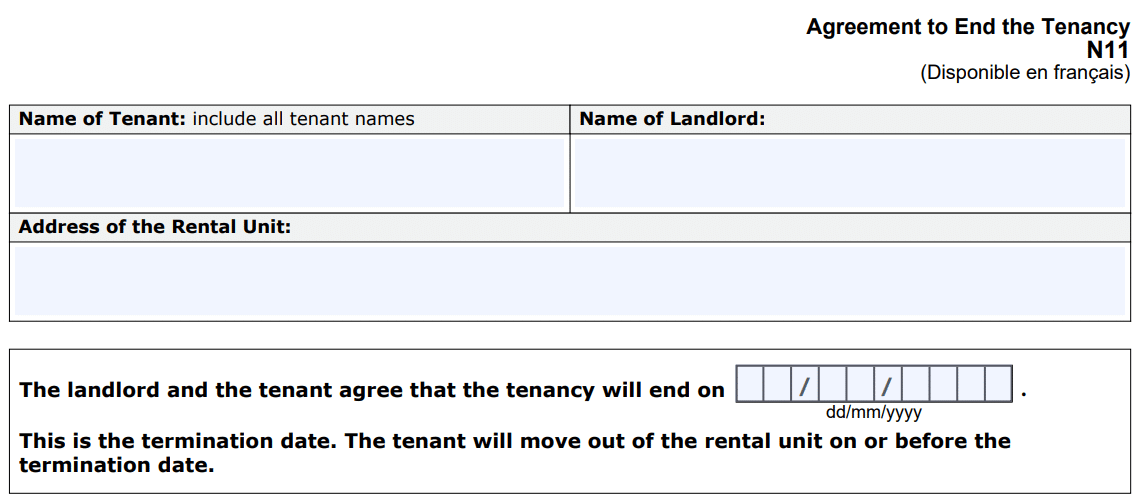
The N11 is a short form from the Landlord and Tenant Board. It says you and your landlord agree to end the tenancy on a set date. That is the whole job of the form.
It differs from most LTB forms in one big way. Other termination forms start a process where one side acts against the other. The N11 records a decision you reach together. Because the agreement is mutual, the law treats it as binding once both sides sign. Section 37 of the Residential Tenancies Act, 2006 allows a landlord and tenant to end a tenancy by agreement without any notice form.
You can use it for any kind of tenancy, fixed term or monthly. You can use it whether you rent a house, an apartment, a condo, or a basement unit. What you cannot do is use it to push out someone who has not agreed.
When to Use the N11 Form
Picture this. You rent a one bedroom on a one year lease, and four months in you land a job in another city. You need to leave by the end of next month. Your landlord is fine with it and already has someone lined up for the unit. An N11 lets you both write down the new end date and move on. You owe rent up to that date and nothing after.
People reach for the N11 for plenty of reasons. A job move. A tenant buying a home. A landlord and tenant parting on good terms. A fixed term lease that one side wants to end early with the other side’s blessing. The form never asks why. It only asks for the date you both pick.

N11 Compared With Other LTB Termination Forms
The N11 is one of several LTB forms tied to ending a tenancy, and they are easy to mix up. Here is how the main ones compare.
| Form | Who uses it | Purpose | Agreement needed |
| N11 | Landlord and tenant together | End the tenancy on a date both choose | Yes, both must sign |
| N9 | Tenant | Tenant gives notice to move out | No, the tenant decides |
| N12 | Landlord | Owner, a close family member, or a buyer wants the unit | No, but the landlord must prove it |
| N13 | Landlord | Major repairs, demolition, or conversion | No, but notice and compensation rules apply |
| N4 | Landlord | Notice for unpaid rent | No |
The deciding factor is consent. The N11 and N9 both rest on choice. The N12, N13, and N4 do not, which is why they carry notice periods, evidence rules, and in some cases compensation. If your landlord hands you an N11 but the situation looks more like an N12, meaning they want the unit for themselves, that is worth a second look before you sign. For a related landlord notice and how it works, read our guide on the N5 form.
How to Fill Out the N11 Form
A valid N11 needs a handful of details. Keep them accurate, because mistakes can sink the agreement later. Include the following.
- Every tenant’s full name, matching all names on the lease
- The landlord’s name
- The full address of the rental unit, including the unit number
- The agreed termination date, written clearly
- A phone number for each party
- The signature and date for each party
You can download the current form straight from Tribunals Ontario. Both of you keep a signed copy. You do not send the form to the LTB at this stage, a point many guides get wrong.
Signing the N11 Is Voluntary, and That Protects You
Here is the part the rushed version of this story leaves out. An N11 is void if you sign it at the start of the tenancy or as a condition of getting the unit. A landlord cannot make signing an N11 part of the deal to rent to you. If they do, the agreement has no force. Section 37 of the Act spells this out.
There is one narrow exception, for students living in college or university residences, where different rules apply.
So if a landlord asks you to sign an N11 on the same day you sign your lease, stop. That document would not hold up, and a landlord who pushes it may be trying to skip the protections the law gives you.
“We see N11s signed under pressure more often than people expect,” say the experienced lawyers at Insight Law Professional Corporation. “A signature you felt forced into is not the mutual agreement the form is meant to capture, and the Board can refuse to enforce it.” If you feel unsure, get independent legal advice before you put your name on anything.
What the N11 Does Not Do
Signing an N11 commits you to one thing, leaving by the agreed date. It does not erase your other rights under the Residential Tenancies Act. If your landlord owed you something before you signed, say for a repair problem or a charge that was not allowed, the form does not wipe that out on its own.
It is not a free pass for the landlord either. The agreement binds both sides to the same date. The landlord cannot move the date afterward, and neither can you, unless you both agree in writing.
What Happens After You Sign
Once you both sign, the tenancy is set to end on the agreed date. Keep your copy somewhere safe.
You pay rent up to the termination date and not a day past it. If you paid a deposit at the start, it was a last month’s rent deposit, which is the only deposit Ontario allows. The landlord applies it to your final rental period. Ontario landlords cannot collect a separate damage or security deposit, so there is nothing of that kind to hand back.
A move out walkthrough is smart practice, even though the law does not require one for this form. It gives both sides a record of the unit’s condition and heads off arguments later.
If the Tenant Does Not Move Out
Most N11s end quietly, with the tenant gone on time. When that does not happen, the landlord has a clear path. Under section 77 of the Residential Tenancies Act, the landlord can apply to the LTB for an order ending the tenancy and evicting the tenant, using Form L3. The landlord attaches the signed N11 and a sworn statement.
Two timing points matter. The landlord must file the L3 within 30 days after the agreed termination date. Miss that window and the agreement can no longer be enforced this way. The Board can then issue the order without holding a hearing, because the signed agreement already shows both sides consented.
A tenant who believes the order is wrong can ask the Board to set it aside within 10 days. That is the tenant’s safety valve if something about the agreement was off.
Joint Tenancy Situations
When more than one tenant is on the lease, every one of them has to sign the N11 for it to end the tenancy. One roommate cannot end the tenancy for the others. List all tenants by name on the form.
If some sign and some do not, the tenancy does not end. It continues for the tenants who did not agree, with the same rights and duties as before. In a shared rental, you need everyone on board before the form means anything.
Why a Mutual Agreement Matters Right Now
Ending a tenancy through the LTB’s contested process is slow. The Board received 87,993 applications in the 2024 to 2025 fiscal year, and its backlog still sat above 41,000 cases at the end of that year, according to the Tribunals Ontario annual report. Processing times ran roughly three to seven months, far longer than the three to seven weeks renters and landlords saw back in 2018.
A clean N11 sidesteps most of that delay. There is no contested hearing to wait for when both sides already agree. For a landlord who needs the unit back and a tenant who is ready to go, the mutual route is faster and cheaper than a fight. That is the practical case for getting the form right the first time.
Benefits and Cautions at a Glance
| What the N11 gives you | What to watch for |
| A clean end date both sides accept | Signing under pressure can make it unenforceable |
| No reason or grounds required | Signing it at the start of a tenancy makes it void |
| No contested hearing when both sides agree | Every joint tenant must sign or the tenancy continues |
| Flexible date that fits both schedules | Read the date twice, it binds you once signed |
Frequently Asked Questions
What is the N11 form used for?
It lets a landlord and tenant in Ontario agree to end a tenancy on a date they both pick. It records a mutual decision, not a one sided eviction.
Can one party use the N11 form on their own?
No. The N11 only works when both the landlord and tenant sign. A landlord who wants to end a tenancy without the tenant’s agreement has to use a different process, such as an N12 or an N4.
Do I have to sign an N11 if my landlord asks?
No. Signing is your choice. You cannot be forced, and an N11 you signed as a condition of renting the unit is void. If you feel pressured, pause and get advice before you sign.
Do I send the N11 form to the Landlord and Tenant Board?
Not on its own. You and your landlord each keep a signed copy. The form only goes to the LTB if the tenant does not move out and the landlord files an L3 application to enforce it, which must happen within 30 days after the agreed date.
What happens if the tenant does not move out by the agreed date?
The landlord can apply to the LTB for an eviction order using Form L3 and attach the signed N11. Because the agreement already shows consent, the Board can grant the order without a hearing.
Can I change my mind after signing?
A signed N11 binds both sides. You can change or cancel it only if you both agree in writing. Otherwise you are expected to move out on the date you chose.
The information provided above is of a general nature and should not be considered legal advice. Every transaction or circumstance is unique, and obtaining specific legal advice is necessary to address your particular requirements. Therefore, if you have any legal questions, it is recommended that you consult with a lawyer.
